
Tabla de Contenido
Have you ever stopped to think about all those small details that make it possible for electricity to flow smoothly in your daily life? The truth is that, although they often go unnoticed, electrical connectors are true unsung heroes. They are the components that join cables, devices, and elements, creating a bridge through which current travels. Without them, something as simple as charging your phone or turning on the TV would be impossible—or at least, very complicated and dangerous.
But don’t think all connectors are the same — far from it! Imagine you need to connect two water pipes; you wouldn’t use the same fitting for your garden hose as you would for a main industrial pipeline, right? Well, electricity works the same way. There are hundreds, perhaps thousands, of types of connectors, each designed for a very specific purpose. They can be temporary, like the plugs you use at home, or permanent, like the soldered joints you see on a printed circuit board.
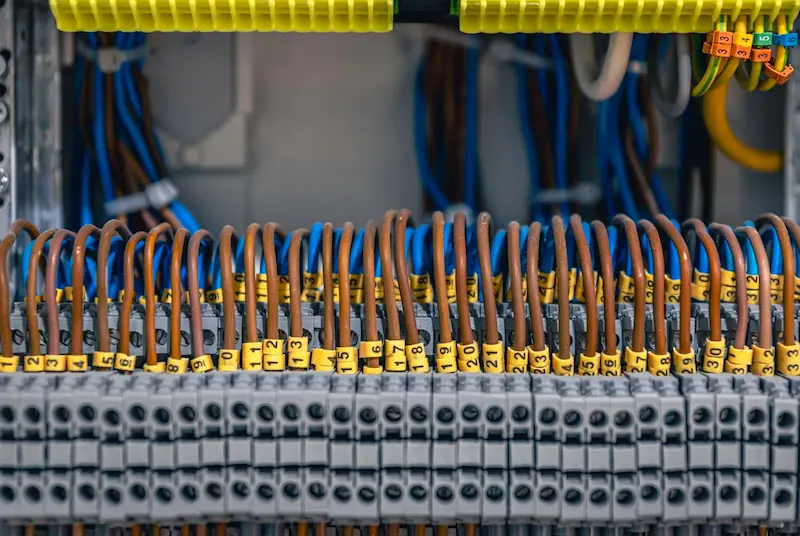
Electrical connectors are fundamental components in any electrical or electronic system, acting as the junction point that enables the safe and efficient flow of electric current between different devices, cables, and equipment. Choosing the right connector type is crucial to ensure reliability, safety, and optimal performance of installations.
Key Points
- Vital Bridges: Connectors are the heart of any electrical system, allowing current to flow safely and efficiently.
- Amazing Variety: From simple male/female connectors to robust circular ones, there’s a connector for every purpose and environment.
- Safety and Performance: Choosing the right connector is crucial to avoid failures, overheating, and to ensure durability of devices and installations.
Why Are They So Essential?
The main function of a connector is to ensure a secure and stable connection. This isn’t just about convenience—it’s vital for safety and efficiency. A poor connection can lead to serious problems: from system failures and energy loss to overheating and, in the worst cases, even fires. That’s why selecting the right connector is just as important as the quality of the cable or device itself.
The Anatomy of a Perfect Connection
To better understand their importance, think of electricity as water flowing through a pipe. The connector is the joint. If the joint is weak, the water leaks or loses pressure. In electrical terms, this means resistance, voltage drop, and ultimately malfunction or risk. Good connectors ensure electricity flows without obstacles, minimizing losses and maximizing performance.
General Classification of Electrical Connectors
By Main Function
Power Connectors
Power connectors are specialized in transmitting electrical energy and are classified according to the voltage they handle. Light-duty connectors operate at voltages equal to or below 1,000 V (AC) or 1,500 V (DC), ideal for household and portable equipment. Medium-duty connectors handle a range from 1,000 V to 35,000 V (or up to 33 kV) and require specific contact materials to prevent electrical wear, while high-voltage connectors support voltages above 35,000 V (or 35 kV) and are used in large-scale power distribution.
Signal Connectors
Designed for transmitting data, audio, video, and control signals, these connectors prioritize signal integrity over power capacity. Their construction minimizes electromagnetic interference and maintains characteristic impedance.
By Physical Configuration
Circular Connectors
Circular connectors stand out for their robustness and versatility, used mainly in industrial, military, and aerospace applications. Their cylindrical design provides excellent mechanical strength and allows multi-pin configurations for mixed signals.
Rectangular Connectors
Rectangular connectors offer higher connection density and easier customization through modular designs. Their shape allows better space utilization on panels and equipment.
Connector Selection Criteria
Electrical Parameters
- Rated Voltage: Must exceed the operating voltage with an appropriate safety margin according to applicable standards.
- Rated Current: Current capacity must account for ambient temperature and duty cycle.
- Impedance: Critical in RF applications to maintain signal integrity.
Environmental Parameters
- IP Protection Rating: Defines resistance to ingress of solids and liquids per IEC 60529.
- Temperature Range: Must cover expected operating and storage conditions.
- Vibration Resistance: Especially important in mobile and industrial applications.
Mechanical Parameters
- Mating Cycles: Number of connection/disconnection cycles the connector can withstand.
- Insertion/Extraction Force: Must be suitable for the application and user.
- Contact Materials: Gold, silver, tin, or alloys depending on conductivity and corrosion requirements.
Crucial Parameters for Correct Selection
Honestly, choosing poorly can mean anything from a minor headache to a major safety risk. But getting it right saves you time, money, and most importantly, gives you peace of mind. Don’t underestimate the power of these small components—they are the glue that keeps our electrical world running smoothly.
Trends and Future Developments
Miniaturization and Density
The trend toward more compact devices drives the development of high-density connectors with smaller footprints. Advances in materials and manufacturing processes allow maintaining electrical performance in increasingly smaller formats.
Advanced Materials
The development of new materials includes alloys with better conductivity, high-temperature polymers, and advanced coatings that improve durability and reduce maintenance.
Sustainability
The industry is evolving toward more sustainable connectors through the use of recyclable materials, efficient manufacturing processes, and designs that facilitate disassembly at end of life.
Safety Certifications
Connectors must comply with appropriate safety certifications depending on their application and target market. This includes CE marking for Europe.
Installation and Maintenance
Best Installation Practices
- Cable Preparation: Use proper tools to strip and prepare conductors without damaging the wires.
- Tightening Torque: Apply the specified torque to ensure a secure contact without damaging the connector.
- Environmental Protection: Use sealants, protective sleeves, or enclosures as required by environmental conditions.
Preventive Maintenance
- Visual Inspection: Regularly check connectors for corrosion, mechanical damage, or overheating signs.
- Resistance Measurement: Monitor contact resistance to detect deterioration before failures occur.
- Cleaning: Keep connectors free from contamination by periodically cleaning them with appropriate methods.
Selecting the right electrical connectors requires understanding the technical specifications, environmental conditions, and regulatory requirements of each application. Connector technology continues to evolve to meet the demands of higher performance, miniaturization, and sustainability in an increasingly connected world.
Electrical connectors represent a critical element whose correct specification and application determine the reliability, safety, and efficiency of modern electrical and electronic systems. A deep understanding of their characteristics and applications is essential for professionals, technicians, and users seeking optimal solutions for their specific projects.