
Tabla de Contenido
- Key Points for a Safe Connection
- Why the Aluminum–Copper Connection Needs Special Care?
- Professional Methods for a Safe and Durable Connection
- Essential Materials and Tools for the Connection
- Step-by-Step: A Proper Aluminum-to-Copper Connection
- Key Applications of the Aluminum–Copper Connection
- Standards, Compatibility and Quality Control
- Quick Comparison of Al/Cu Solutions
- Frequently Asked Questions
- Conclusion
When you need to make a proper aluminum-to-copper connection in your installations, you face a critical challenge. The direct joint of these metals, with different electrochemical properties and thermal expansion coefficients, can cause galvanic corrosion, overheating and, in the worst case, fire hazards, as documented by InterNACHI in its studies on aluminum wiring. Your concern is understandable: you need reliability and safety to avoid costly failures and constant repairs.
Mastering the right techniques will allow you to create durable connections that exceed 15 years of service life, ensuring the safety and efficiency of your systems. You will discover methods endorsed by international standards and practical solutions used by industry professionals.
With the right information and tools, you can optimize the performance of your installations, reduce energy consumption caused by hot spots and ensure operational continuity. Get ready to make connections that withstand the passage of time and the most demanding conditions.
Key Points for a Safe Connection
- Prevention of galvanic corrosion: Use specialized bimetallic connectors or tin-plated copper to avoid direct contact.
- Compensation of thermal expansion: Use connectors designed to absorb the expansion differences between both metals.
- Use of antioxidant compounds: Apply specific greases to maintain conductivity and protect against aluminum oxidation.
- Certification and standards: Make sure that materials and methods comply with international and national standards.
Why the Aluminum–Copper Connection Needs Special Care?
Joining aluminum and copper conductors is not a simple task and presents unique challenges due to the intrinsic properties of each metal. Ignoring these differences can lead to safety issues and operational failures in any electrical installation or piping system. A proper aluminum-to-copper connection is essential for long-term reliability.
Galvanic Corrosion
When aluminum and copper come into direct contact, especially in the presence of moisture or electrolytes (such as condensation, rain or environmental pollution), a galvanic cell is formed. In this electrochemical process, aluminum acts as the anode, sacrificing itself and corroding at an accelerated rate. The resulting aluminum oxide is an electrical insulator, which greatly increases resistance at the contact point, creating hot spots. Technical studies show that this corrosion can reduce the service life of the connection by up to 70% in humid environments.
- Aluminum is a more reactive metal, which makes it susceptible to rapid oxidation.
- Moisture acts as an electrolyte, facilitating the galvanic reaction.
- Aluminum oxide is non-conductive, which increases resistance and heat.
Differences in Thermal Expansion and Conductivity
Another inherent issue in a proper aluminum-to-copper connection lies in their different thermal expansion coefficients. Aluminum expands and contracts about 1.5 times more than copper with temperature changes. During heating and cooling cycles (for example, due to load fluctuations or ambient temperature), this disparity generates mechanical stresses that can loosen joints over time. Even minimal loosening increases contact resistance and causes overheating, which can lead to failures and fire hazards. In addition, the electrical conductivity of copper (about 58×106 S/m) is higher than that of aluminum (about 37×106 S/m), requiring larger aluminum cross-sections to carry the same current, which must be considered in connection design.
- Aluminum expands and contracts more than copper, creating mechanical stress.
- Thermal cycles can loosen connections, increasing resistance and heat.
- The lower conductivity of aluminum requires a larger cross-section to match the current capacity of copper.
Professional Methods for a Safe and Durable Connection
There are several validated, standards-compliant techniques to achieve a proper aluminum-to-copper connection. The most suitable method will depend on the specific application, environment and technical requirements of the installation.
Bimetallic Transition Connectors
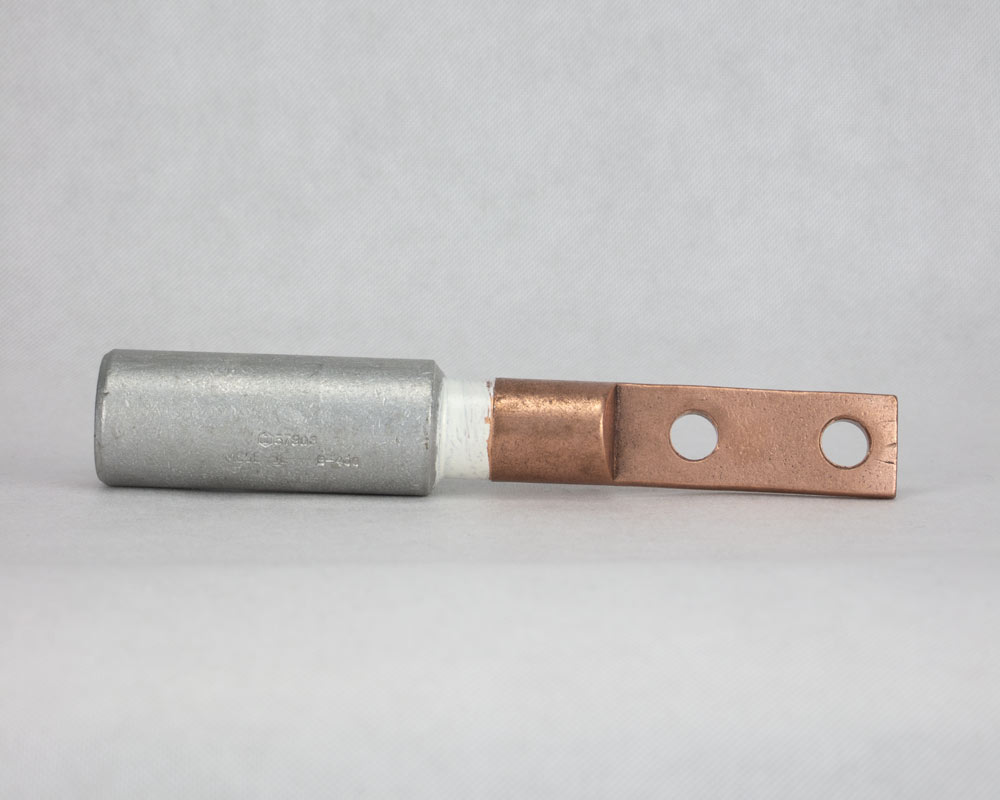
Bimetallic connectors are the most effective and widely recommended solution for joining aluminum and copper. These devices are designed with a metallurgically welded interface (usually by friction) between an aluminum section and a copper section, preventing direct contact of the dissimilar metals and thus galvanic corrosion. They come in various forms, such as lugs, compression terminals and adapters, suitable for different types of conductors and applications.
- Bimetallic lugs connect aluminum conductors to copper busbars.
- Compression connectors are ideal for permanent splices.
- Threaded terminals allow removable connections.
- They are manufactured with Al–Cu friction welding to minimize corrosion.
Tin-Plating of the Copper Conductor
For direct connections, especially in smaller sections or dry environments, tin-plating the end of the copper cable is a preventive measure. It consists of coating the copper with a layer of tin, creating a barrier that slows galvanic corrosion when in contact with aluminum. This process must be carried out meticulously to be effective.
- Thoroughly clean the copper conductor to remove oxides and impurities.
- Apply a suitable tinning flux to promote tin adhesion.
- Tin with tin–lead or lead-free solder, ensuring uniform coverage.
- Clean flux residues after tinning to avoid future corrosion.
Mechanical Connections with Antioxidant Compounds and Sealants
Bolted or compression-terminal connections require the essential use of specific antioxidant compounds for aluminum–copper. These conductive pastes, often greases with oxidation inhibitors, fill microscopic gaps, break the aluminum oxide (alumina) layer and create a protective barrier that prevents the entry of moisture and oxygen, key elements for galvanic corrosion.
- Antioxidant compounds prevent oxide formation on contact surfaces.
- Sealants protect against moisture, which acts as an electrolyte.
- Keeping the connection free of air and moisture significantly extends its service life.
Essential Materials and Tools for the Connection
To ensure a proper aluminum-to-copper connection, selecting appropriate materials and tools is as important as the technique used. Using certified and calibrated products ensures compliance with standards and the durability of the installation.
Certified Specialized Connectors
Connectors must meet quality and safety standards, such as NTC 4627 for compression and mechanical connectors for power cables. Recognized brands offer solutions designed specifically for aluminum–copper transition, ensuring a low-resistance, highly reliable joint.
- Reducing connectors to join aluminum conductors (DIN EN/IEC 60228) with copper.
- Bimetallic compression terminals of high quality.
- Mechanical connectors with variable range, ideal for maintenance and retrofits.
- Ideal Industries’ Twister Al/Cu connectors are recognized for their reliability in preventing corrosion.
Antioxidant Compounds and Pastes
Choosing the right antioxidant compound is vital for connection longevity. These products must have specific characteristics to work effectively in aluminum–copper joints.
- Dielectric properties to help prevent galvanic corrosion.
- High thermal conductivity to dissipate generated heat.
- Stability over wide temperature ranges.
- Resistance to being washed away by water or moisture.
Crimping and Verification Tools
Using correct, calibrated tools is critical for joint quality. Poor crimping or incorrect tightening torque can compromise connection integrity.
- Crimping tools calibrated and specific to the connectors and cable diameters.
- Torque wrenches to apply the exact tightening torque on mechanical connectors.
- Crimping gauges and contact-resistance meters to verify joint quality.
Step-by-Step: A Proper Aluminum-to-Copper Connection
The following is a systematic process for making a proper aluminum-to-copper connection, minimizing risks and ensuring durability.
Conductor Preparation and Stripping
Thorough conductor preparation is the first crucial step for a reliable connection.
- Strip the conductor to the exact length specified by the connector manufacturer; avoid cutting or damaging cable strands.
- Clean the exposed aluminum surface with a wire brush to remove the oxide layer.
- Immediately apply the antioxidant compound to the stripped end of the aluminum conductor to prevent re-oxidation.
- Check the conductor cross-section with a gauge or cable marking to ensure compatibility with the connector.
Controlled Crimping or Tightening
Applying the proper pressure is essential to establish a low-resistance, mechanically stable connection.
- For compression connectors: use the tool and dies certified by the manufacturer for the connector and cable cross-section. Follow the recommended crimping pattern.
- For mechanical connectors: use a torque wrench to apply the exact tightening torque indicated by the manufacturer. If there are multiple screws, tighten them in a cross pattern for uniform pressure.
- Mark the connector after tightening or crimping for quality control and record-keeping.
Sealing and Environmental Protection
Protection against moisture and the environment is essential to extend the life of the proper aluminum-to-copper connection, since moisture greatly accelerates galvanic corrosion and oxidation.
- Use heat-shrink tubing with internal adhesive or resin/gel kits to achieve a hermetic seal with the appropriate IP protection rating.
- For junction boxes, ensure they are watertight and have good drainage to avoid condensation buildup.
- Consider additional dielectric coatings or barriers on bolted joints exposed to the elements.
Key Applications of the Aluminum–Copper Connection
The ability to safely join aluminum and copper has enabled significant developments in various industries, leveraging the light weight and low cost of aluminum together with the high conductivity of copper.
Power Distribution Networks
In power distribution networks, aluminum is used extensively in high-voltage conductors due to its light weight and cost-effectiveness. However, at connection points and terminals, copper is preferred for its low resistance and superior reliability. It is common to find proper aluminum-to-copper connections in power transformers (where aluminum connects to copper terminal blocks) and in substations, where aluminum bus ducts connect to copper rails, requiring specialized bimetallic terminals.
- Use of aluminum conductors for high-voltage lines due to economic efficiency and weight.
- Use of copper terminals for low resistance and high reliability at critical connection points.
- Applications in substations and transformers for network interconnection.
Refrigeration and Air-Conditioning Systems
In the HVAC industry (heating, ventilation and air conditioning), there is often a need to join copper piping with aluminum piping, especially in evaporators and condensers. Direct welding between these metals is complex due to their different melting points and the formation of brittle intermetallic compounds. For this reason, specific techniques or non-welded methods are used.
- Joining pipes in evaporators and condensers of air-conditioning systems.
- Non-welded methods such as the Miracle Lokring compression ring, which prevents electrochemical corrosion.
- Welding with special rods and controlled preheating for copper-to-aluminum joints.
Industrial Installations and Renewable Energy
In industrial environments and renewable-energy projects (such as photovoltaic installations), bimetallic connectors facilitate an efficient, safe proper aluminum-to-copper connection. They are used to connect conductors in power, control and distribution systems. For example, OTL series connectors are designed for copper–aluminum transitions in ranges from 6 to 95 mm², making them ideal for applications demanding reliable performance under demanding conditions.
- Efficient connections in power, control and distribution systems.
- Use in photovoltaic projects and other renewable-energy installations.
- Robust solutions for applications requiring reliable, durable performance.
Standards, Compatibility and Quality Control
To ensure a proper aluminum-to-copper connection, it is essential to comply with current standards and establish rigorous quality controls.
Standards and Technical Criteria
Proper application of technical standards is fundamental. Conductors must comply with standards such as DIN EN/IEC 60228, which specify the characteristics of copper and aluminum cables. Compression or mechanical connectors used for transition must be specifically certified for Al/Cu joints.
- Verify that the conductors comply with the appropriate class and cross-section according to DIN EN/IEC 60228.
- Ensure that the connectors are certified for aluminum-to-copper joints.
- Keep records of tightening torque, connector type and, if possible, perform pull tests or thermographic inspections.
Post-Installation Verification
Post-installation control can prevent failures and extend the life of the connection.
- Perform a resistance/impedance measurement of the joint to ensure it is within reference values.
- Carry out a thermographic inspection under load to detect hot spots indicative of high resistance.
- Establish a retightening plan in electrical panels or areas with strong thermal cycles to maintain contact pressure.
Quick Comparison of Al/Cu Solutions
To make it easier to choose a proper aluminum-to-copper connection, this table summarizes the main solutions and their characteristics.
| Solution | Main Application | Key Advantages | Necessary Precautions |
|---|---|---|---|
| Al/Cu Bimetallic Terminal | Connect Al cable to Cu bar or cable | Low resistance, metallurgical joint, high reliability | Requires proper crimping and environmental sealing |
| Al/Cu Mechanical Connector | Variable ranges, maintenance, no crimping tool | Fast assembly, section versatility | Requires controlled tightening torque and watertight enclosure |
| Joint Compound (Antioxidant) | Any joint with aluminum | Breaks oxide, improves contact, protects against moisture | Does not replace a bimetallic connector, must be used with one |
| Tin-Plating of Copper | Small copper-to-aluminum sections (dry environments) | Creates a barrier against galvanic corrosion | Not a complete bimetallic solution, must be combined with sealing |
Frequently Asked Questions
Can aluminum and copper conductors be joined directly?
This is not recommended under any circumstances. Direct contact causes galvanic corrosion and a significant increase in electrical resistance, which leads to overheating and fire risk. It is essential to use specialized transition methods such as bimetallic connectors and antioxidant compounds.
Which antioxidant compound should be used in joints with aluminum?
You should use electrical joint compounds specific for aluminum–copper, such as Alnox UG from AFL Global. These compounds contain conductive particles that break aluminum oxide and create a barrier against moisture. They are applied on the aluminum side before assembly to ensure conductivity and prevent corrosion.
Is crimping or a mechanical connector better for Al/Cu joints?
Both methods are valid if certified Al/Cu connectors are used and the manufacturer’s instructions are followed. Crimping provides a very stable, low-resistance joint if done with the right tools and dies, while mechanical connectors are more versatile for variable cable ranges and easier maintenance but require controlled tightening torque with a torque wrench.
How can the aluminum–copper joint be protected from moisture?
To protect the joint from moisture, it is recommended to use heat-shrink tubing with internal adhesive, resin or gel kits, or watertight boxes with the appropriate IP protection rating. Ensuring a hermetic seal that prevents water and condensation entry is crucial, as moisture accelerates galvanic corrosion.
Which standards should be considered for an Al/Cu connection?
Standards such as DIN EN/IEC 60228 for conductor compatibility and specific standards for compression or mechanical connectors that allow Al/Cu transition (such as NTC 4627) must be considered. Always follow the connector and tool manufacturer’s specifications to ensure compliance.
Why does an Al/Cu terminal get hot?
An Al/Cu terminal heats up due to high contact resistance. This can be caused by poor surface preparation (aluminum oxide), insufficient tightening, absence or improper application of antioxidant compound, or moisture ingress that accelerates galvanic corrosion. Thermographic inspection can identify these hot spots.
Conclusion
A proper aluminum-to-copper connection is a fundamental aspect of the safety and efficiency of any electrical installation or piping system. The electrochemical interaction and differences in thermal expansion between these metals demand a technical approach and the use of specific solutions. From selecting certified bimetallic connectors and using antioxidant compounds to proper tool use and environmental sealing, each step is crucial to preventing failures, overheating and ultimately fire risks. Adhering to standards and performing preventive maintenance will ensure the durability and reliability of your connections, giving you the resources to create safe, long-lasting joints in Spain and beyond.